
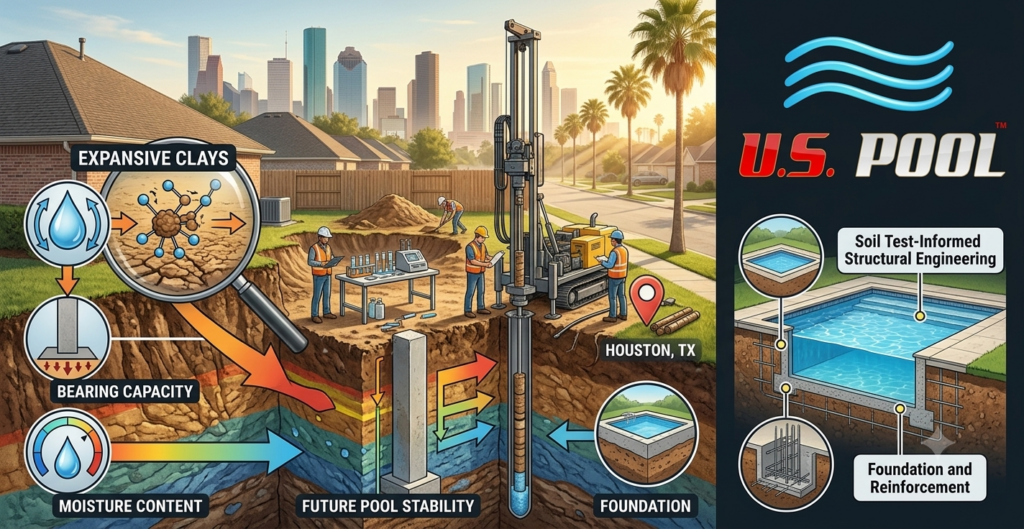
Why Soil Testing Matters Before Installing a Swimming Pool
Installing a swimming pool is a significant investment that requires careful planning, proper engineering, and an understanding of the ground conditions surrounding the property. While homeowners often focus on pool design, decking, landscaping, and water features, the condition of the soil beneath the proposed pool is equally important. Soil testing helps determine whether the ground can support the weight of the pool structure and withstand the pressures associated with excavation, groundwater, and changing moisture levels. In Greater Houston, where clay-rich soils, heavy rainfall, and fluctuating weather conditions can influence ground stability, understanding soil composition is particularly valuable before construction begins. We consider soil conditions an important part of the planning process because they can affect structural durability, construction methods, drainage requirements, and long-term maintenance. At U.S. Pool Builder, we recognize that evaluating the ground before excavation helps homeowners make informed decisions and establish a stronger foundation for their swimming pool project.
Understanding Greater Houston’s Unique Soil Conditions
Greater Houston presents several soil-related challenges that homeowners should understand before beginning a swimming pool installation. Many areas throughout the region contain expansive clay soils that absorb moisture and swell during wet periods, then shrink as the ground dries. These repeated changes in soil volume can create movement beneath and around a pool structure, potentially contributing to cracking, uneven settlement, or stress on connected plumbing. Soil conditions can also vary considerably between neighboring properties because of differences in natural deposits, previous grading, imported fill, and construction history. Some locations may have sandy or silty layers, while others contain dense clay, poorly compacted fill, or soils affected by nearby drainage patterns. Because these variations influence excavation stability and structural support, we recommend evaluating the specific property rather than assuming that general information about Greater Houston soils applies equally to every backyard.
What Is Soil Testing Before Pool Construction?
Soil testing is the process of examining ground materials to determine their physical properties and suitability for a planned construction project. Before swimming pool installation, a geotechnical professional may collect soil samples, examine subsurface layers, and conduct field or laboratory tests to assess important engineering characteristics. These tests can help establish soil classification, moisture content, density, strength, compressibility, and potential expansion or shrinkage behavior. Depending on the property and project requirements, the investigation may also examine groundwater conditions and the depth of different soil layers beneath the proposed pool location. The resulting information helps engineers understand how the ground may respond to excavation, construction loads, and environmental changes over time. We use this type of site-specific information to support better planning and identify conditions that may require additional engineering attention before pool construction proceeds.
Evaluating Soil Bearing Capacity for Structural Stability
One of the primary purposes of soil testing is to evaluate the ground’s ability to support the loads imposed by a swimming pool. A pool filled with water places substantial pressure on the underlying soil, while the surrounding deck, retaining walls, equipment pads, and other structures introduce additional loads. If the soil cannot adequately support these forces, the pool may experience excessive settlement or differential movement, in which one section shifts differently from another. Such movement can place stress on the pool shell, coping, deck joints, and underground plumbing connections. Soil bearing capacity depends on several factors, including soil type, density, moisture conditions, and the depth of the supporting layer. By understanding these factors before excavation, we can help ensure that the pool design and construction approach account for the site’s actual ground conditions rather than relying on assumptions.
Identifying Expansive Clay and Potential Ground Movement
Expansive clay is a particularly important consideration for swimming pool projects in the Greater Houston area because it can change volume as its moisture content fluctuates. During periods of heavy rainfall, clay particles absorb water and may cause the soil to expand, while prolonged dry weather can lead to shrinkage and ground movement. When these changes occur unevenly around a swimming pool, they can place pressure on the pool shell and surrounding hardscape. Tree roots, leaking irrigation lines, poor drainage, and concentrated roof runoff can contribute to localized moisture differences that make ground movement less uniform. Soil testing helps determine whether the site contains clay with significant shrink-swell potential and whether additional geotechnical evaluation is necessary. We consider this information essential when planning pool construction because understanding soil movement risks early can help guide appropriate engineering measures and reduce the likelihood of avoidable structural problems.
Determining Whether the Soil Is Suitable for Excavation
Excavation is one of the earliest and most important stages of swimming pool construction, and soil conditions can directly influence how safely and efficiently this work proceeds. Some soils remain relatively stable when excavated, while loose sand, saturated soil, or weak fill may be more prone to sloughing, caving, or collapse. These conditions can affect excavation dimensions, equipment access, construction sequencing, and the safety measures required during the project. The presence of buried debris, old construction materials, or inconsistent fill can also complicate excavation and create areas that require removal or additional preparation. Soil investigations can help identify these concerns before construction crews encounter them in the field. Our planning process takes the site’s physical characteristics into account so that excavation requirements can be evaluated alongside the pool’s dimensions, access limitations, and structural specifications.
Understanding Groundwater and Drainage Conditions
Groundwater conditions are another important factor to evaluate before installing an inground swimming pool in Greater Houston. Depending on the location, recent rainfall, seasonal conditions, and subsurface geology, groundwater may be present at a depth that affects excavation or pool construction. Water entering an excavation can soften certain soils, interfere with construction activities, and create additional demands for temporary dewatering or drainage management. Groundwater can also exert upward pressure on an empty pool shell, creating a potential risk of flotation if the structure and drainage system are not appropriately designed for the site’s conditions. This risk is especially important when a pool is drained for repairs or maintenance because the water inside the pool normally helps counteract external forces. We encourage homeowners to consider groundwater management during the planning stage so that any necessary drainage provisions, structural safeguards, and professional engineering recommendations can be addressed before installation begins.
The Importance of Soil Compaction and Existing Fill
Not every backyard contains undisturbed natural soil, particularly in neighborhoods where properties have undergone previous construction, grading, or landscaping work. Builders may have placed imported fill to raise elevations, level the yard, or prepare the property for earlier improvements. If this material was not placed and compacted properly, it may settle under the weight of a pool and its surrounding structures. Uneven compaction can produce differential settlement, which may affect the pool shell, deck surfaces, retaining walls, and connected utility lines. Soil testing and geotechnical evaluation can help identify questionable fill materials and determine whether further investigation or corrective preparation is needed. When existing fill is present, we believe it is important to establish whether the material provides suitable support before relying on it as the foundation for a permanent swimming pool.
How Soil Testing Influences Swimming Pool Design
The findings from a soil investigation can influence several aspects of swimming pool design, including structural requirements, foundation preparation, drainage planning, and the treatment of surrounding areas. For example, expansive clay may require engineering measures that account for potential ground movement, while weak or compressible soil may call for additional evaluation of the pool’s support conditions. Sites with significant elevation changes or unstable slopes may require retaining structures or other measures designed by qualified professionals. Groundwater concerns may also influence decisions about drainage provisions and the structural design of the pool shell. Soil conditions can affect the planning of nearby patios, outdoor kitchens, pool houses, and other improvements that add loads or change how water flows across the property. By reviewing these factors before finalizing construction details, we can help homeowners understand why a pool design should reflect the specific characteristics of the site instead of following a one-size-fits-all approach.
Protecting Pool Plumbing and Surrounding Hardscape
The ground beneath a swimming pool is only part of the equation because the surrounding soil also affects the performance of plumbing systems and outdoor surfaces. Pool plumbing lines are installed underground and may be vulnerable to movement when soil expands, shrinks, settles, or becomes saturated. Changes in ground conditions can place stress on pipe connections, potentially contributing to leaks or alignment problems that are difficult to locate after the landscape has been completed. Pool decks and patios can also experience movement when the supporting soil is poorly compacted or exposed to inconsistent moisture conditions. Cracks, uneven surfaces, and separation around coping or deck joints may develop when different sections respond differently to changing ground conditions. We account for these relationships during project planning because a well-designed pool area should function as an integrated system, with the pool structure, plumbing, drainage, and surrounding hardscape considered together.
Soil Testing and Property Drainage Planning
Effective drainage is especially important in Greater Houston, where intense rainfall can introduce large amounts of water into residential yards over a relatively short period. When rainwater collects near a swimming pool, it can saturate surrounding soil, contribute to erosion, and create localized pressure against underground structures. Poor drainage may also allow water to flow toward the excavation, affect nearby foundations, or leave the pool deck surrounded by persistently wet ground. Soil testing can provide information about permeability and subsurface conditions, although a complete drainage assessment may also require an evaluation of property elevations, surface runoff, downspout locations, and existing drainage systems. Depending on the findings, the project may need grading adjustments, surface drainage improvements, or engineered subsurface solutions. We emphasize drainage planning because controlling where water travels across the property can help protect the pool area and reduce the effects of repeated wetting and drying on the surrounding soil.
When Should Homeowners Schedule Soil Testing?
Homeowners should consider soil testing early in the swimming pool planning process, ideally before the final design and construction arrangements are established. Conducting the investigation before excavation allows the project team to evaluate potential ground conditions and incorporate necessary recommendations into the construction plan. Waiting until excavation begins may reveal unexpected soil problems that require redesign, additional engineering, or changes to the construction schedule. Early testing can be particularly useful for properties with a history of settlement, substantial grading, retaining walls, drainage difficulties, or previous structural repairs. It may also be appropriate when the proposed pool will be located near an existing home, property boundary, large trees, or other structures affected by soil movement. At U.S. Pool Builder, we encourage homeowners to discuss site conditions during the initial planning stage so that the need for a geotechnical investigation can be evaluated before major construction expenses are committed.
What Happens During a Professional Soil Investigation?
A professional soil investigation generally begins with a review of the property, the proposed pool location, available site information, and the project’s engineering requirements. Depending on the complexity of the site, a geotechnical professional may use borings, test pits, or other approved methods to examine the soil beneath the surface. Samples may then be analyzed to determine properties such as soil classification, moisture content, plasticity, density, and strength. The investigation may also evaluate the depth of groundwater, the presence of fill, and changes in soil characteristics across different layers. After testing, the professional typically prepares findings and recommendations that help the design and construction teams understand relevant site conditions. The scope of the investigation should be tailored to the project because a straightforward residential pool installation may require a different level of assessment than a pool on a steep lot or a property with documented ground instability.
Soil Testing for Different Types of Swimming Pools
Different swimming pool construction methods have different structural requirements, so soil conditions should be evaluated in relation to the selected pool type. Concrete pools offer considerable flexibility in shape and design, but their structural systems must be engineered to account for site conditions and anticipated ground movement. Fiberglass pools rely on a manufactured shell, making proper excavation, bedding, backfilling, and groundwater management important considerations during installation. Vinyl liner pools also require suitable excavation preparation and stable support beneath the pool floor, along with careful attention to backfill and drainage conditions. Although the construction methods differ, no pool type is completely independent of the soil surrounding and supporting it. We consider the intended pool design alongside the geotechnical findings so that installation requirements can be assessed according to the manufacturer’s instructions, applicable engineering guidance, and the characteristics of the property.
How Soil Testing Can Help Manage Construction Costs
Soil testing adds an upfront expense to a swimming pool project, but the information it provides can help homeowners make better decisions about construction planning and risk management. Without an adequate understanding of site conditions, unexpected groundwater, unstable excavation walls, poorly compacted fill, or expansive soil may lead to delays and additional work. Correcting these problems after the pool has been installed can be more complicated because access to the affected areas may be restricted by the pool shell, deck, landscaping, and underground utilities. Early identification allows the project team to evaluate appropriate solutions and incorporate them into the construction budget where necessary. Soil testing cannot eliminate every construction risk or guarantee that repairs will never be needed, but it can reduce uncertainty by identifying important ground conditions before work progresses too far. We view this process as an investment in informed planning, helping homeowners balance their preferred pool design with the practical requirements of building safely on a particular property.
Warning Signs That May Indicate Soil Problems
Certain property characteristics may suggest that additional soil evaluation is worth considering before a swimming pool is installed. Existing cracks in nearby foundations, retaining walls, driveways, or patios can sometimes indicate settlement or soil movement, although other causes are also possible. Areas of persistent standing water, repeated yard erosion, or noticeably soft ground may point to drainage problems or unfavorable subsurface conditions. A property that has been extensively filled, raised, or regraded may also require closer attention because the quality and compaction of the placed material can vary. Sloping yards and locations close to drainage channels may introduce additional stability and water-management considerations that should be evaluated professionally. These signs do not automatically mean that a pool cannot be installed, but they indicate that the project team should understand the underlying conditions before deciding how to proceed.
Working With Qualified Pool Builders and Geotechnical Professionals
Successful pool installation depends on coordination between the homeowner, pool builder, engineers, and other qualified professionals involved in the project. A pool builder can help identify site conditions that warrant further investigation and coordinate the construction requirements with the appropriate specialists. A geotechnical professional evaluates the soil and provides recommendations within the scope of the investigation, while a structural engineer can use relevant site information to assess the pool’s structural requirements. Drainage specialists or civil engineers may also be needed when surface runoff, grading, or groundwater management presents additional challenges. Clear communication among these professionals helps ensure that important recommendations are understood and incorporated into the design and construction process. At U.S. Pool Builder, we recognize the value of addressing site-specific concerns early because a coordinated approach can help prevent avoidable surprises and support a more reliable construction outcome.
Building a Swimming Pool With Long-Term Stability in Mind
A swimming pool should provide years of enjoyment, and achieving that goal requires more than selecting attractive finishes or installing high-quality equipment. The soil beneath and around the pool influences structural support, drainage performance, excavation stability, and the behavior of nearby hardscape over time. Greater Houston’s variable soil conditions make it especially important to understand how clay expansion, seasonal moisture changes, groundwater, and existing fill may affect an individual property. Soil testing provides valuable information that helps engineers and construction professionals make decisions based on measured conditions rather than assumptions. When these findings are incorporated into the design, excavation, foundation preparation, and drainage planning, homeowners can make more informed choices about their investment. We believe that careful preparation is one of the most practical ways to support a swimming pool project designed for dependable performance and lasting enjoyment.
Start Your Greater Houston Swimming Pool Project With Proper Site Evaluation
Planning an inground swimming pool in Greater Houston begins with understanding the property on which it will be built. Before construction starts, homeowners should discuss the proposed pool location, soil characteristics, drainage patterns, groundwater concerns, and any previous signs of settlement with their pool builder. A site-specific evaluation can help determine whether geotechnical testing is necessary and whether additional engineering recommendations should be incorporated into the plans. This preparation can also help clarify excavation requirements, identify potential complications, and establish a more realistic construction budget. Every property is different, so the most appropriate approach depends on the ground conditions, pool design, site layout, and recommendations of qualified professionals. U.S. Pool Builder encourages homeowners to make soil conditions part of their early planning discussions so they can move forward with a clearer understanding of the requirements for a well-planned swimming pool installation.