
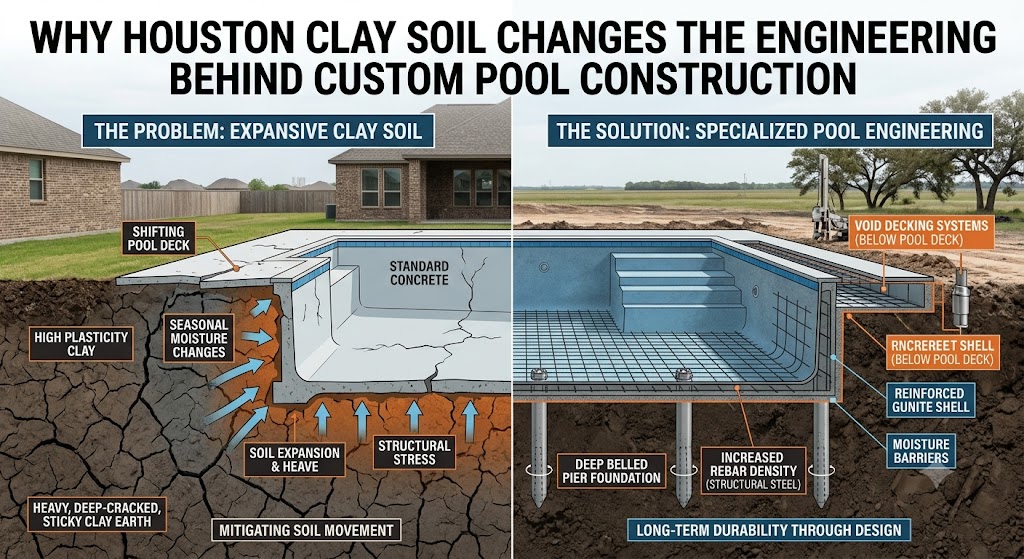
Why Greater Houston Clay Soil Changes the Engineering Behind Custom Pool Construction
Building a custom swimming pool is never simply a matter of choosing a shape, selecting finishes, and excavating a hole in the backyard. The conditions beneath the surface play a major role in determining how a pool should be engineered, constructed, and protected over time. In the Greater Houston area, expansive clay soil creates a particularly important set of challenges for residential pool construction. This soil can absorb substantial amounts of water, expand during wet conditions, and contract significantly when moisture levels decline. Those movements can place considerable pressure on structures built within or directly above the soil. For this reason, successful custom pool construction in Greater Houston requires a detailed understanding of soil behavior and a construction strategy designed specifically for local ground conditions.
Understanding the Nature of Greater Houston’s Clay Soil
Greater Houston and surrounding communities are widely known for soils containing significant amounts of expansive clay. Unlike stable granular soils that allow water to move relatively freely, clay particles can retain moisture and change volume as water content fluctuates. During periods of heavy rainfall, the soil can swell and exert upward or lateral pressure on nearby structures. During extended dry periods, the same soil can shrink and create voids or uneven support beneath concrete elements. This continuous cycle of expansion and contraction is one of the most important engineering considerations for any permanent structure built on Greater Houston properties. A swimming pool must therefore be designed with the understanding that the ground supporting it may not remain completely static throughout the year.
The effects of expansive clay are not always immediately visible to homeowners. Soil movement often occurs gradually and can vary significantly across different areas of the same property. One section of the yard may retain moisture while another dries much faster because of sunlight exposure, drainage patterns, landscaping, or nearby structures. Tree roots can also influence soil moisture by drawing water from surrounding areas, potentially contributing to localized shrinkage. These differences can create uneven movement beneath and around a pool shell if they are not properly considered during planning. Understanding the specific site conditions before construction begins helps create a stronger foundation for long-term structural performance.
Why Soil Movement Matters for Pool Structures
A custom swimming pool is a large and rigid structure that depends on balanced support from the surrounding soil. When expansive clay moves unevenly, different sections of the pool may experience different forces. Upward soil pressure can push against portions of the shell, while shrinking soil can reduce support beneath other areas. Over time, this differential movement may contribute to stress within concrete, plumbing connections, decking, and surrounding hardscape. A properly engineered pool must account for these forces rather than assuming the excavation site will remain unchanged after construction. This is why the engineering phase is especially important when building pools in regions with active clay soils.
The pool shell itself must be viewed as a structural system rather than simply a concrete container for water. Reinforcement placement, concrete thickness, beam design, excavation preparation, and soil interaction all work together to determine how the structure responds to ground movement. Even a visually beautiful pool can face long-term issues if the engineering behind it does not match the site’s conditions. Water adds significant weight to a completed swimming pool, and that weight interacts with both the structural shell and the supporting ground. Engineers and experienced builders must therefore consider the relationship between soil pressure, hydrostatic conditions, structural loads, and seasonal moisture changes. At U.S. Pool Builder, we approach custom pool construction with the understanding that what happens below ground is just as important as the design homeowners see above it.
Site Evaluation Should Influence the Design
Every backyard presents a different combination of soil composition, drainage patterns, elevation changes, vegetation, and existing structures. A pool design that performs well on one property may require adjustments when built on another site only a few miles away. Before construction, evaluating the property helps identify conditions that may influence excavation methods and structural requirements. Areas with poor drainage may experience prolonged saturation, while elevated sections of the property may dry more quickly during hot weather. Existing foundations, retaining walls, utilities, and mature trees can further affect how soil behaves around the proposed pool location. These factors should be considered early because changing engineering decisions after excavation has begun can be more complicated and costly.
The location of the pool within the yard can also influence long-term performance. Positioning a pool near large trees, major drainage paths, or structures with different foundation systems may introduce additional variables. Tree roots can alter moisture levels in expansive soils, while roof runoff can concentrate water in certain areas if drainage is not properly managed. A thoughtful site plan considers how water naturally moves across the property during storms and how the landscape may change during dry periods. Proper grading around the completed pool is equally important because uncontrolled water can contribute to inconsistent soil moisture conditions. By integrating site evaluation into the design process, we can make more informed decisions about both structural engineering and the overall backyard layout.
Structural Reinforcement Requires Greater Attention
Concrete pool construction depends heavily on steel reinforcement to help the shell resist structural stresses. In clay soil environments, reinforcement design becomes particularly important because the pool may be exposed to movement and pressure from multiple directions. The goal is not simply to add more material without purpose but to create a properly engineered structural system appropriate for the site. Reinforcing steel helps distribute loads throughout the pool shell and provides resistance against cracking forces that may develop from soil movement. The arrangement and connection of reinforcement must work together with the concrete shell rather than functioning as isolated components. Careful attention to structural continuity helps create a stronger pool capable of responding to the environmental conditions around it.
The pool’s walls, floor, bond beam, steps, benches, and other structural features must also be considered as part of the complete system. Complex pool designs can introduce changes in depth, angles, and load distribution that require additional engineering attention. Features such as raised spas, vanishing edges, retaining structures, and elevated decks can further increase structural complexity. Greater Houston homeowners often want highly customized outdoor spaces, which means the engineering must support both aesthetics and performance. A simple rectangular pool and a multi-level freeform pool may interact with the surrounding soil in very different ways. This makes professional planning essential when combining ambitious architectural features with challenging ground conditions.
Drainage Becomes Part of the Engineering Strategy
Water management is closely connected to the behavior of expansive clay soils. Excessive moisture can cause clay to swell, while prolonged dryness can cause it to contract. Although no construction system can eliminate natural seasonal changes, proper drainage can help reduce unnecessary water accumulation around the pool and surrounding structures. Pool decks, landscaping, gutters, and nearby hardscape should all be designed with consideration for how runoff moves through the property. Standing water near the pool is not simply a surface-level inconvenience because it may influence the moisture content of the underlying soil. Effective drainage planning therefore contributes to both the usability of the outdoor space and the long-term stability of the construction.
Surface drainage should be coordinated with the entire backyard design rather than treated as an afterthought. For example, deck slopes should direct water away from structures while maintaining comfortable and visually appealing outdoor surfaces. Landscaping should avoid creating areas where water becomes trapped against the pool or adjacent foundations. Downspouts and roof runoff may need to be directed carefully so large volumes of water are not repeatedly introduced into the same section of soil. Drainage solutions must also account for Greater Houston’s intense rainfall events, which can deliver significant amounts of water within a relatively short period. When we plan a custom pool environment, drainage considerations are integrated into the broader construction strategy because soil moisture management can influence the performance of the entire outdoor space.
Excavation Is More Than Digging a Pool Shape
Excavation is one of the first moments when the actual conditions beneath a property become fully visible. Surface observations can provide useful information, but excavation reveals variations in soil layers, moisture conditions, and other site-specific characteristics. The excavation process must create the proper geometry for the pool while avoiding unnecessary disturbance to surrounding structures and property features. In clay-heavy environments, maintaining the intended structural preparation of the excavation is particularly important. Contractors must also account for weather because heavy rain can quickly alter excavation conditions and introduce additional water into exposed soils. Proper sequencing and site management during this stage help establish the conditions needed for the next phases of construction.
The excavation process can also influence decisions related to plumbing placement and structural transitions. A custom pool may include multiple depths, tanning ledges, spas, benches, and other features that create varying excavation requirements. Each transition must work with the structural design rather than simply following an aesthetic concept. The surrounding soil exerts pressure on the completed pool shell, so the shape of the excavation and preparation of structural elements must be carefully coordinated. Construction teams should avoid treating complex pool features as decorative additions disconnected from the engineering process. The strongest results occur when architecture, structural planning, and site conditions are considered together from the beginning.
Plumbing Systems Must Accommodate Structural Reality
A pool’s plumbing system is another important consideration when dealing with soil movement. Pipes, fittings, returns, drains, and equipment connections must function reliably while being integrated into a structure that may experience environmental stresses over time. Poorly planned plumbing can become vulnerable if connections are placed without consideration for structural transitions or potential movement. Proper installation techniques and pressure testing help verify system integrity before the pool is completed and covered by finishes. Accessibility and equipment layout should also be considered because future maintenance is an inevitable part of pool ownership. Engineering a custom pool therefore involves coordinating structural and mechanical systems rather than focusing exclusively on the concrete shell.
The complexity increases when a pool includes additional water features or attached structures. Spas, waterfalls, deck jets, bubblers, fire features with integrated water systems, and automated circulation equipment may require extensive coordination. Every additional feature introduces more connections and potential points where construction quality matters. A comprehensive approach ensures that plumbing routes are compatible with the pool’s structural design and equipment requirements. This is especially important in custom projects where no two layouts are exactly the same. Thoughtful coordination during construction can reduce the likelihood of unnecessary modifications later and help create a more efficient, maintainable pool system.
Decking and Hardscape Face the Same Soil Challenges
The swimming pool shell is not the only part of the project affected by Greater Houston clay soil. Decking, patios, outdoor kitchens, walkways, and other hardscape elements also rest on or interact with the surrounding ground. If soil movement occurs unevenly, these surfaces may experience settlement, shifting, or changes in elevation over time. Proper base preparation and drainage are therefore important for the entire outdoor environment. The relationship between the pool and adjacent hardscape must be carefully planned so each component can perform according to its intended structural characteristics. A beautiful pool area depends on more than the pool itself because the surrounding surfaces play a major role in functionality and visual cohesion.
Expansion joints and properly designed transitions can help manage the relationship between different structural elements. Rigid materials naturally respond differently to environmental conditions, and thoughtful detailing helps accommodate those differences. Large uninterrupted concrete surfaces may require specific planning to control where movement and cracking are managed. Outdoor kitchens and other heavy features can introduce additional loads that should be considered during site preparation. Greater Houston’s combination of expansive soil, intense rainfall, and high summer temperatures makes comprehensive hardscape planning particularly valuable. A custom backyard should be engineered as an integrated environment rather than a collection of independent features constructed without coordination.
Seasonal Weather Creates Changing Conditions
Greater Houston’s weather patterns create a constantly changing environment for expansive clay soils. Periods of heavy rain can saturate the ground and increase soil volume, while hot and dry weather can remove moisture and lead to contraction. These changes do not necessarily happen uniformly across an entire property. Shaded areas may retain moisture longer, while exposed sections of the yard can dry rapidly under intense sunlight. Landscaping, irrigation systems, and drainage patterns can further influence these differences. For pool construction, this means engineering decisions should consider long-term environmental cycles rather than focusing only on the conditions present on the day excavation begins.
Homeowners can also play a role in maintaining consistent conditions around their completed outdoor space. Significant changes to drainage patterns, landscaping, or irrigation after construction may affect how water interacts with the soil surrounding the pool. For example, removing large trees, adding extensive landscaping, or redirecting roof runoff can alter local moisture patterns. Regular maintenance of drainage systems helps prevent avoidable water accumulation in sensitive areas. While seasonal soil movement is a natural characteristic of the region, unnecessary extremes in moisture variation should be minimized whenever possible. Understanding this relationship allows homeowners to make better long-term decisions about their property after the pool project is complete.
Custom Engineering Supports Custom Design
A truly custom pool should not rely on a one-size-fits-all construction approach. The design should respond to the homeowner’s vision while also respecting the realities of the property. Soil conditions, elevation, drainage, desired features, and surrounding architecture all influence the engineering requirements. A dramatic geometric pool with raised walls may require a different structural strategy than a natural freeform pool integrated into a landscaped backyard. Similarly, a pool with an attached spa, outdoor kitchen, and large covered patio introduces additional coordination challenges. Custom construction means adapting the project to the site instead of forcing the site to fit a standardized template.
This connection between design and engineering is particularly important in Greater Houston because the ground itself can influence construction decisions. Architectural creativity should be supported by sound structural planning rather than separated from it. Homeowners should be able to explore features that improve their lifestyle while understanding how those features interact with the property. Early collaboration between design and construction professionals can identify potential challenges before they become expensive field changes. The result is a more cohesive project where structural performance and visual appeal reinforce each other. At U.S. Pool Builder, we believe the best custom pools begin with a complete understanding of both the homeowner’s vision and the conditions beneath the property.
Long-Term Performance Begins Before Construction
The most important decisions affecting a pool’s longevity are often made before the first concrete is placed. Site evaluation, structural planning, drainage strategy, material selection, and construction sequencing all contribute to long-term performance. Cutting corners during early planning may not immediately affect the appearance of a newly completed pool, but hidden construction decisions can have lasting consequences. A well-engineered project considers potential stresses and environmental conditions before they become problems. This proactive approach is particularly important in areas where expansive clay creates an active relationship between the soil and built structures. Investing time in proper planning helps establish a stronger foundation for the entire project.
Homeowners should also recognize that custom pool construction is a combination of architecture, engineering, excavation, plumbing, concrete work, and landscape planning. Each discipline influences the others, particularly when challenging soil conditions are involved. A successful project requires coordination rather than isolated decisions made independently by different trades. The goal is to create an outdoor environment that looks exceptional while also being built with the realities of the property in mind. Greater Houston clay soil may introduce additional engineering considerations, but those considerations can be addressed through informed planning and experienced construction practices. U.S. Pool Builder focuses on bringing these elements together to create custom pool environments designed around both the beauty homeowners want and the conditions their property demands.
Building Smarter for Greater Houston’s Ground Conditions
Greater Houston’s clay soil is one of the most important factors influencing how a custom swimming pool should be planned and constructed. Its ability to expand and contract with changing moisture levels means that soil cannot be treated as a passive backdrop to the construction process. Structural reinforcement, excavation preparation, drainage planning, plumbing coordination, and hardscape design must all account for the unique behavior of the ground. The strongest approach is one that examines the entire property and recognizes how each component of the outdoor environment interacts with the others. This level of planning helps support better construction decisions and creates a more complete understanding of the challenges involved. Rather than viewing soil conditions as an obstacle, experienced pool professionals use site knowledge to guide smarter engineering and construction strategies.
For homeowners planning a custom pool in Greater Houston, understanding what lies beneath the backyard is just as important as choosing the visible design features above it. Clay soil can influence structural decisions from the earliest stages of planning through the final installation of decking and landscaping. Every property has unique conditions, which is why careful evaluation and customized solutions are essential. A pool should be designed not only for how it will look on completion day but also for how it will exist within its environment for years to come. When engineering, construction quality, drainage, and design are considered together, homeowners can move forward with greater confidence in their investment. The result is a custom pool built with a deeper understanding of the Greater Houston landscape and the forces that shape it.